
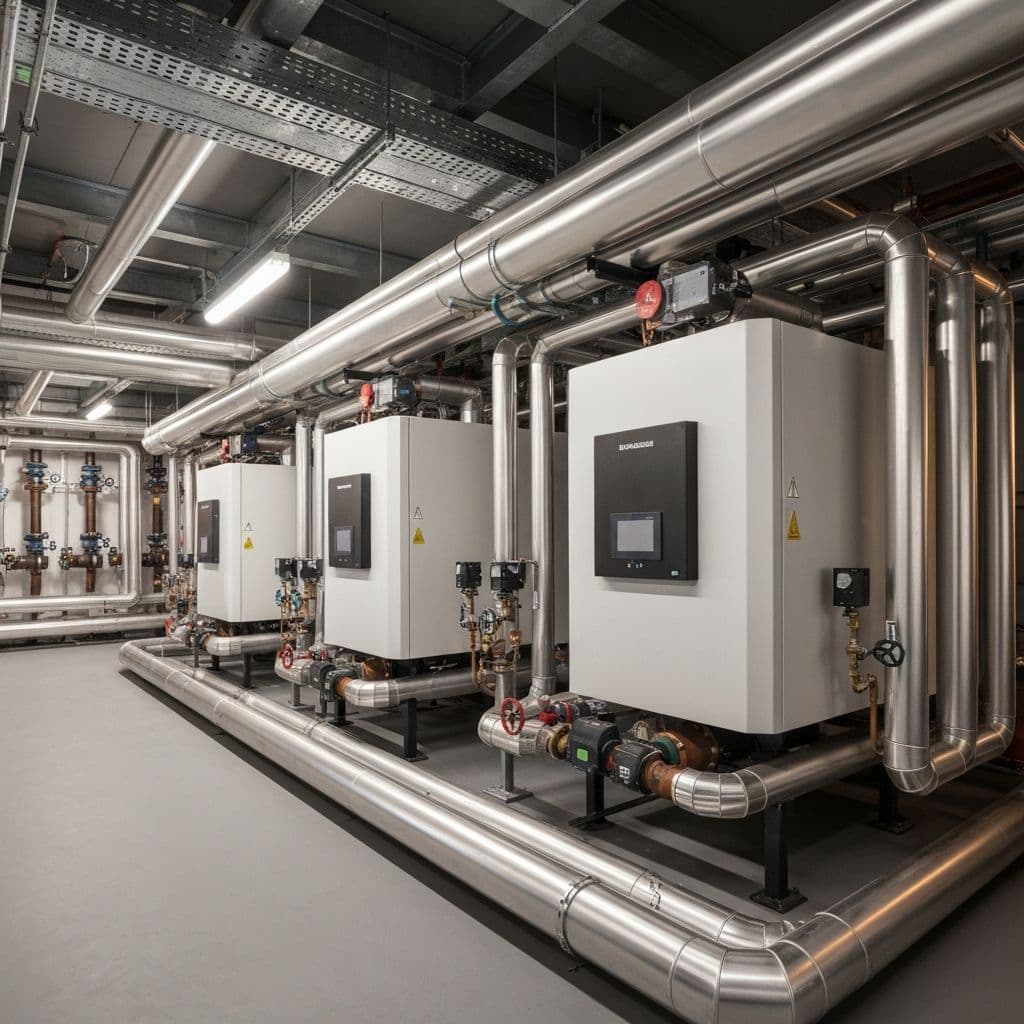
Professional heating and heat pumps in Morocco
Space heating, domestic hot water and industrial preheating. Solutions sized from a heat load calculation, for commercial and industrial buildings.
What we install
Our solutions cover space heating, domestic hot water production and heat recovery, for commercial, retail and industrial buildings.
- Air-to-air and air-to-water heat pumps
- Condensing gas boilers
- Domestic hot water production
- Heat recovery from refrigeration plant
- Hydraulic underfloor heating
- Radiators and fan coil units
- Storage cylinders and recirculation loops
- Controls and energy metering
- Servicing and breakdown cover
- Heat load calculation and sizing
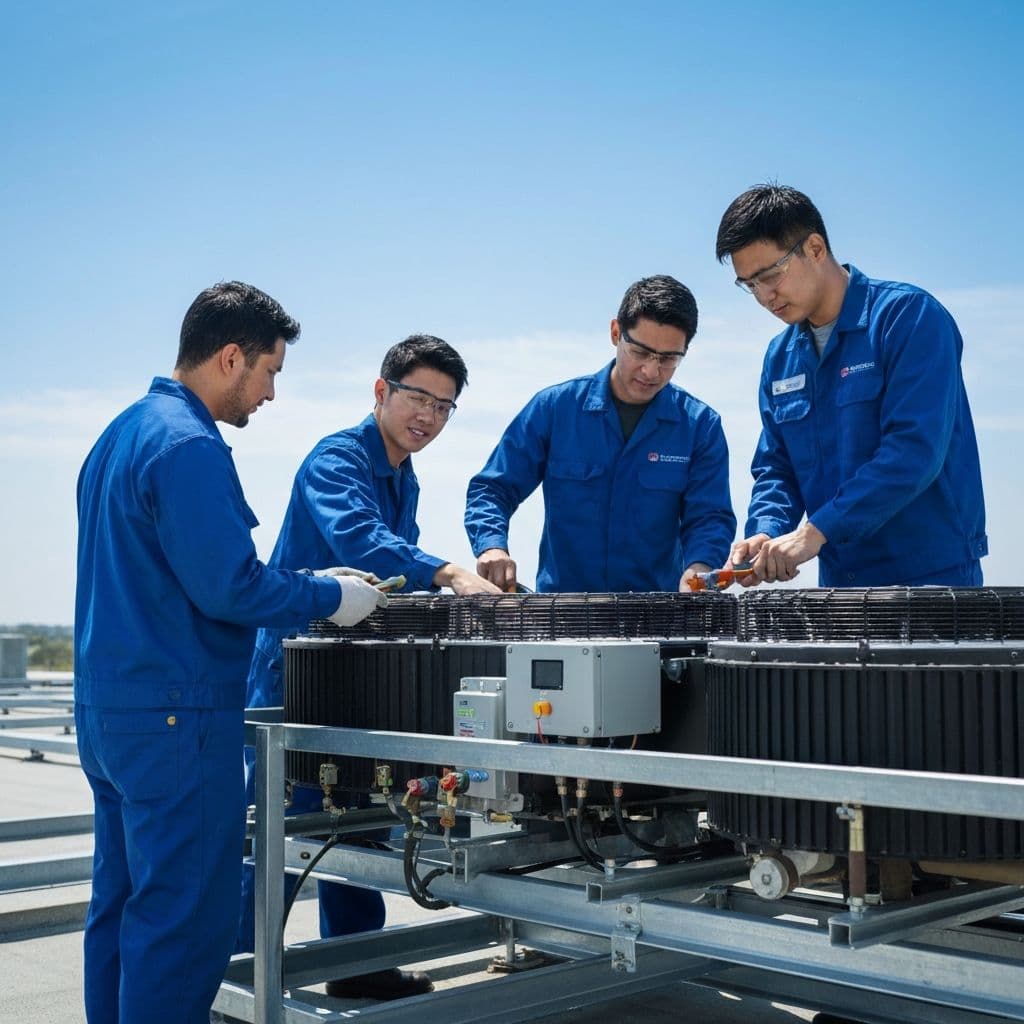
Professional heating in Morocco
Professional heating covers the systems that produce and distribute heat for a building or a process: space heating, domestic hot water production, industrial preheating.
In Morocco the requirement looks nothing like a continental climate. On the coast winters are mild and the space heating load stays moderate; it is domestic hot water that dominates, all year round, in hospitality, healthcare and food processing. Inland, in Fez, Meknes, Ifrane or Midelt, winter is real and space heating becomes the main item again.
That difference drives the choice of solution. Equipment sized for a winter peak lasting a few weeks a year runs at part load the rest of the time, which is where its efficiency is worst.
Four families, four uses
| Solution | Main use | Flow temperature | Watch out for |
|---|---|---|---|
| Air-to-water heat pump | Space heating and domestic hot water | 35 to 55 °C | Efficiency falls as the required temperature rises |
| Reversible air-to-air heat pump | Heating and cooling the same space | Supply air | Does not produce domestic hot water |
| Condensing gas boiler | Buildings needing hot water, or as a top-up stage | Up to 80 °C | Efficiency depends on a cool enough return |
| Dedicated domestic hot water plant | Hospitality, healthcare, changing rooms, food processing | Depends on the sanitary treatment chosen | Storage and the recirculation loop matter as much as production |
These families combine more often than they compete: a heat pump carries the base load all year, a top-up stage covers the peak and the thermal treatment.
What determines the capacity?
Capacity does not follow from floor area. It comes out of a heat load calculation adding the building's losses to the real hot water demand.
- Losses through walls, roof and glazing, based on their actual insulation
- Air renewal, set by the activity rather than by comfort
- The site's design outdoor temperature, not a national average
- The hot water draw-off profile: a hotel and a workshop do not share the same morning peak
- The temperature regime of the emitters already in place
- Free gains: occupants, lighting, machinery
The emitter regime is what gets discovered too late. Replacing a boiler with a heat pump without reviewing radiators designed for very hot water forces the machine to produce at high temperature, exactly where its efficiency collapses. That check belongs before the equipment is chosen, not after.
How does a project unfold?
| Stage | What happens | What you get |
|---|---|---|
| Technical survey | Survey of the building, existing emitters, electrical and gas supply | A written record, not an estimate over the phone |
| Heat load calculation | Losses and hot water demand calculated | Capacity justified by a calculation, with its assumptions |
| Choice of solution | Trade-off between families, accounting for the emitter regime | The reasons for the choice, and what was ruled out |
| Installation | Fitting, hydraulic and electrical connections, controls | A planned site, coordinated with your operations |
| Commissioning | Settings, balancing, readings under real conditions | Measured values at handover, to serve as the reference |
| Follow-up | Periodic servicing and performance checks | A drift caught in the figures before it becomes a breakdown |
Every project is quoted after a technical survey and a heat load calculation. A price given without those two steps rests on nothing verifiable.
Frequently asked questions
Is a heat pump suited to the Moroccan climate?
Yes, and rather better than in northern Europe. A heat pump draws heat from outdoor air; the milder that air, the better its efficiency. Moroccan coastal winters therefore suit it well. Conversely, in cooling mode during a southern summer, outdoor heat degrades efficiency.
What is a quoted COP worth?
It is always given for a specific pair of temperatures. A COP quoted for 35 °C flow will not be reached if your installation needs 60 °C. Ask for performance at the temperatures your building actually requires, and for the seasonal SCOP rather than the instantaneous COP: it is the SCOP that determines the bill.
Can existing radiators be kept?
It depends on their temperature regime. Radiators designed for 80 °C water would force the heat pump to produce at high temperature, where its efficiency is lowest. Recording that regime is part of the technical survey, before any equipment is chosen.
Should heating or hot water come first?
On most Moroccan commercial sites, domestic hot water consumes more over the year than space heating, because the demand is permanent while heating is seasonal. It is therefore often the item to address first.
Can heat be recovered from a refrigeration system?
Yes, and it is the most profitable option where it is available. A refrigeration plant continuously rejects heat at its condenser. Recovering it to preheat water means obtaining that heat for the cost of a heat exchanger and a pump alone. Any site needing both cooling and hot water should examine this before considering another machine.
How do you check the installation delivers what was promised?
By metering. Without an energy meter, real performance will never be known and the commercial commitment stays unverifiable. An installer confident in the sizing offers to measure it.
Need a heating solution?
Our heating experts operate throughout Morocco. Free quote within 24h.